Politics
Lesotho is, of course, a modern state governed by the rule of law. However, due to its historical background, traditional tribal society has been preserved alongside it. This is especially visible in rural areas and is one of Lesotho's defining characteristics.
System of Government
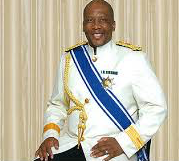 King Letsie III
Lesotho is a constitutional monarchy with a parliamentary system of government. The Prime Minister is the head of the executive branch and oversees the cabinet. The King holds no executive powers and serves a purely ceremonial role. The throne is hereditary within the House of Seeiso; the current king, Letsie III, is the son of the previous king Moshoeshoe II and a direct descendant of the founding king, Moshoeshoe I.
Legislature (Parliament)
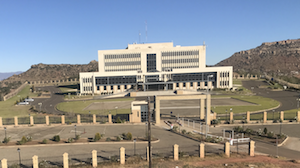 The Parliament Building
Parliament is bicameral, consisting of a lower house (the National Assembly) and an upper house (the Senate). The National Assembly has 120 seats, 80 elected from single-member constituencies and 40 through proportional representation, with members serving five-year terms.
The Senate consists of 33 seats in total: 22 Principal Chiefs and 11 members nominated by the majority party in the National Assembly. The Principal Chiefs' seats are hereditary. The Senate reviews bills sent from the National Assembly and may request amendments, but cannot reject them outright. A bill becomes law once it has passed both houses and been signed by the King.
Executive (Cabinet)
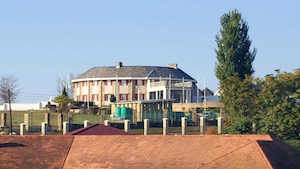 The Prime Minister's official residence
The King appoints the leader of the majority party in the National Assembly as Prime Minister. The Prime Minister nominates ministers from among members of either house, who are then appointed by the King. Each minister heads a government ministry; there are 26 ministries in total, including the Office of the Prime Minister and the Ministries of Agriculture, Communications, Science and Technology, Education and Training, Finance, and Energy, among others.
The cabinet also drafts bills as needed and introduces them to both houses, where they are debated and either approved, amended, or rejected.
Judiciary (Courts)
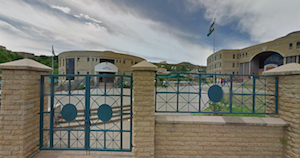 The Court of Appeal / High Court
The judiciary consists of the Court of Appeal, the High Court, and local Magistrates' Courts. There is no jury system. Magistrates' Courts are located in multiple locations across each of the country's 10 districts.
Lesotho's legal system combines general law and customary law. General law is enacted by Parliament, while customary law consists of local customs that have been documented. Which body of law applies depends on the nature of the case: general law tends to apply in urban areas, while customary law is frequently applied in rural areas.
A side note
Many judges on Lesotho's Court of Appeal and High Court are, in fact, South African nationals. Serving as a judge is an extremely specialized profession, and Lesotho may simply not be able to supply enough qualified candidates domestically. When I asked a colleague about this, they told me it was "so that rulings can be made from a neutral, third-party standpoint" — though I'm not entirely sure that's the whole story.
Local Government
Lesotho's local authorities are of three types — the Municipal Council, Urban Councils, and Community Councils — each with its own council. Every council consists of 7 to 15 elected members plus 2 to 3 hereditary Chief members. There is only one Municipal Council (covering the capital, Maseru), 11 Urban Councils nationwide, and 64 Community Councils. Each of these also serves as a constituency for the National Assembly.
Each Community Council is made up of several smaller settlements, each headed by a Chief. The position of Chief is hereditary, though the role today is largely traditional and symbolic. Each Chief reports to one of the country's 22 Principal Chiefs, who hold hereditary seats in the Senate.
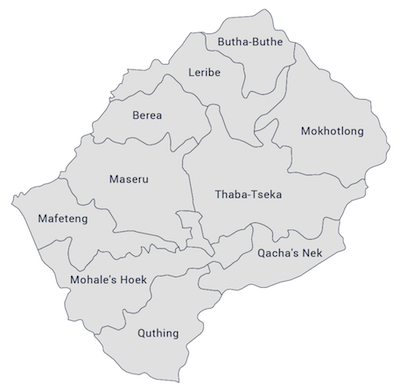
Lesotho is further divided into 10 Districts, to which the Urban and Community Councils belong. The Maseru Municipal Council, however, stands independently and does not belong to any District. Each District Administrator is appointed by the central government, while District Council members are nominated by the Urban and Community Councils.
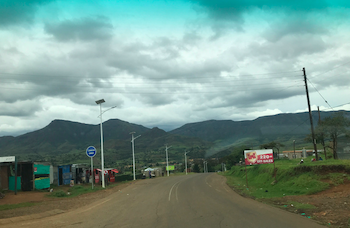 Thaba-Tseka, the district capital of Thaba-Tseka District near the center of Lesotho. Despite being classified as an Urban Council, it is a small town of around 15,000 people.
By population, Maseru District — home to Maseru city — has around 520,000 people, and Berea District, the next largest, has around 260,000.
A side note
On iLesotho, "District" is translated as "ken" (the Japanese term for prefecture), though this is a somewhat imperfect fit. As noted above, the District Administrator is a civil servant appointed by the central government, and District Council members are delegated from the local Urban and Community Councils — neither is directly elected. So a "District" might be more accurately described as a coordinating body between central government and local councils, rather than a local government unit in its own right.