History
The Age of the San People (Bushmen)
From around 1000 BCE through the 16th century, southern Africa was widely inhabited by the San people, a hunter-gatherer people also known as the Bushmen. However, the Sotho, a Bantu-speaking people, migrated southward from the north, displacing the San and gradually settling in what is now the Free State province of South Africa and the area around present-day Lesotho. This territory was divided and ruled by various chiefs.
A side note
"Bantu" is a general term for the Black African peoples belonging to the Bantu language family. They are widely distributed across sub-Saharan Africa, numbering more than 300 million people across over 400 ethnic groups. While the languages share some common features, mutual comprehension between speakers of different Bantu languages is rare.
The Reign of Moshoeshoe I (1822–1868)
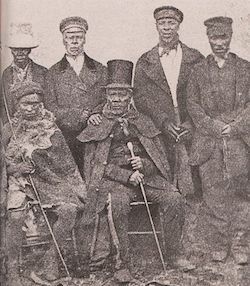 Moshoeshoe I (center) with his senior chiefsIn 1822, Moshoeshoe I became the founding chief who unified the Sotho people, ruling as the first king over the whole territory. However, the kingdom would soon be caught up in colonial conflicts between Britain and the Dutch.
As a result of the Napoleonic Wars, the Dutch ceded the Cape Colony in the southwestern part of South Africa to Britain in 1814. Dutch-descended settlers (the Boers), unwilling to live under British rule, began a large-scale migration into the interior known as the Great Trek starting in 1835.
Through several wars with the Boers who pushed into Lesotho (the Basotho–Boer Wars), Moshoeshoe I lost much of the kingdom's territory. To prevent further losses, he signed an agreement with Britain in 1868 to become a British protectorate, which brought an end to Boer incursions into Lesotho. In the end, however, the kingdom lost roughly 80% of its territory — the entire area of what is now South Africa's Free State province.
A side note (1)
On the land taken from Lesotho, the Boers established their own state, the Orange Free State. Separately, they also founded the Transvaal Republic and the Natalia Republic. All of these territories are now part of South Africa.
A side note (2)
In Sesotho, "Basotho" refers to the Sotho people as a whole, while "Mosotho" refers to an individual Sotho person. This is why, during the British protectorate and colonial period, the territory was known as "Basutoland."
British Rule (1868–1966)
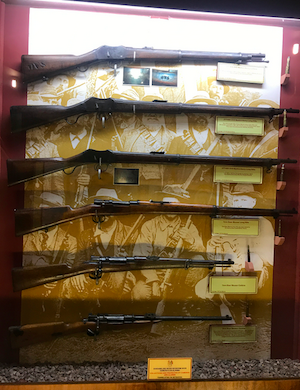 Firearms of the period (on display at the Anglo-Boer War Museum)
Moshoeshoe I died in 1870 and was buried at Thaba Bosiu, then the capital, located about 30 km east of present-day Maseru. From this point, British rule began in earnest.
At first, Britain tried to treat Lesotho the same as other territories it had forcibly annexed, which caused deep resentment among the chiefs. To tighten control further, Britain reduced the chiefs' authority and, by 1880, ordered the chiefs and their forces to disarm and surrender all firearms. Most chiefs refused, leading to a state of war with Britain. The chiefs' forces used the mountainous terrain to wage guerrilla warfare. Although the British forces held an overwhelming advantage in firepower, they suffered heavy losses in this resistance, and the cost of the war became a major burden for Britain (the Cape Colony). A peace treaty was signed the following year, in 1881. This conflict, known as the Gun War (also called the Basotho War), thus ended in victory for the allied Basotho chiefs.
In 1884, Lesotho concluded a new agreement with Britain and once again became a protectorate. Lesotho was placed under a British Resident Commissioner, but local autonomy in each district was left to the respective chiefs, and the right to bear arms was guaranteed.
Independence from Britain (1966–present)
Lesotho (Basutoland) gained independence from Britain in 1966, becoming the Kingdom of Lesotho, with Moshoeshoe II ascending as the first king of the independent nation (the sixth monarch counting from Moshoeshoe I). Leabua Jonathan, leader of the Basotho National Party (BNP), became the first Prime Minister. However, in the country's first post-independence general election in 1970, the BNP suffered a heavy defeat to the Basutoland Congress Party (BCP). Leabua Jonathan nevertheless refused to relinquish power, jailing opposition leaders and building a one-party authoritarian regime.
In 1986, however, the military staged a coup and ousted Leabua Jonathan. Army commander Justin Lekhanya became chairman of the Military Council, and political party activity was banned. King Moshoeshoe II, who opposed military rule, was exiled, and his son Letsie III ascended the throne.
In 1991, another coup occurred: Chairman Justin Lekhanya was ousted, and party politics was restored. However, King Letsie III, seeking absolute monarchy, dismissed the entire cabinet, dissolved parliament, and suspended the constitution. In response, the public launched a general strike and large-scale protests, forcing Letsie III to abdicate. In 1995, his father Moshoeshoe II was reinstated as king, but died in a traffic accident the following year, after which Letsie III ascended the throne again, on condition that he take no part in politics.
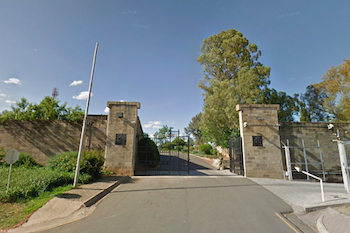 The royal palace in Maseru
In the 1998 House of Assembly elections, the ruling Lesotho Congress for Democracy (LCD) won a landslide victory. However, crowds dissatisfied with the result turned violent, and security deteriorated severely. At the government's request, South African and Botswana troops were deployed for about a year to help restore order. Security stabilized afterward, and the two subsequent general elections were held without major unrest.
A side note
As this shows, Lesotho's post-independence history was marked by repeated political upheavals, coups, and periods of insecurity. Today, however, the political situation is stable, and Lesotho is regarded as one of the few African countries where democracy functions effectively. Security is also relatively good compared with neighboring countries. Perhaps it simply takes around fifty years or so for democracy to take root.